 Barcode Next
UPC-A barcode
Create UPC-A retail barcodes with validation, check digit handling, precise sizing, batch workflows and file export.
Consumer products, particularly in North American retail
What is UPC-A?
UPC-A is a 12-digit retail barcode widely used in North American point-of-sale environments. It represents a GTIN-12 and is closely related to EAN-13.
The symbol uses fixed guard patterns, a required check digit and human-readable digits arranged beneath and around the bar pattern. UPC-A and EAN-13 share a closely related encoding system; nonetheless, the symbol and identifier expected by a receiving retail system should be selected according to that system's requirements.
Data requirements
UPC-A requires twelve numeric digits, including the final mandatory Modulo 10 check digit. The check digit is determined by the preceding eleven digits using a weighted Modulo 10 calculation. A valid checksum identifies a well-formed number, but does not indicate that the associated GTIN-12 has been legitimately assigned.
Structure and sizing
UPC-A uses a fixed 95-module bar pattern with left, center and right guard bars. Its number-system digit and check digit appear outside the main groups of human-readable digits. The six characters encoded on each side of the centre guard form a fixed 95-module pattern. Keep background graphics outside the required quiet zones, and avoid stretching the artwork unevenly when resizing it for packaging.
Technical specifications
- Data
- 11 identification digits plus 1 check digit
- Symbol width
- 95 modules, excluding quiet zones
- Check digit
- Mandatory, GS1 Modulo 10
- Quiet zones*
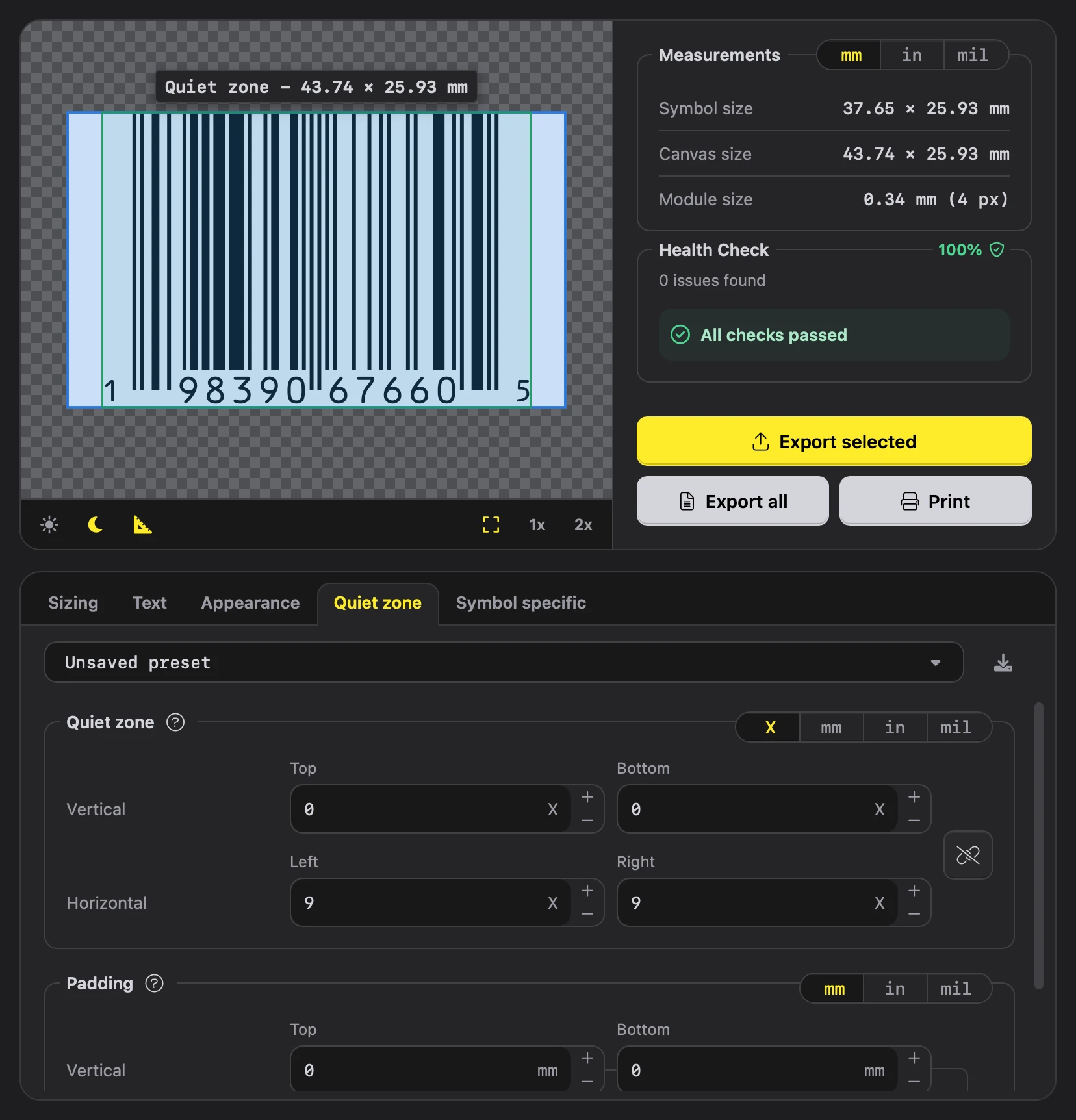
- 9X left, 9X right
- Human-readable text
- Number-system and check digits outside main groups
- Standard
- ISO/IEC 15420 and GS1 rules
- Example UPC-A
- 036000291452
* Quiet zone values are minimum clearances, not fixed margins. Larger clear areas are allowed; the application may require additional space.
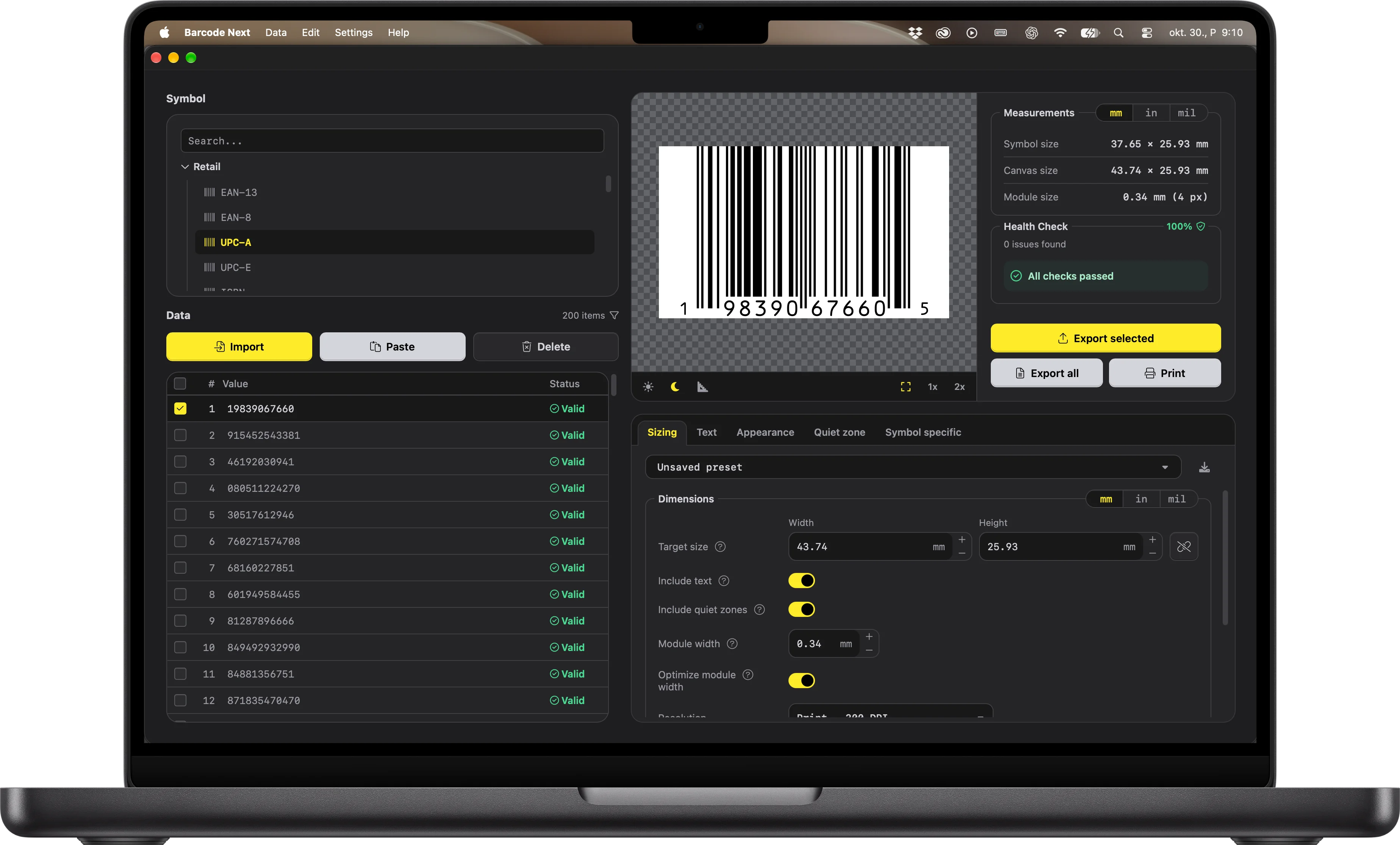
UPC-A in Barcode Next
UPC-A in retail workflows
UPC-A shares the same 95-module encoded width as EAN-13 but has a different interpretation of its twelve digits and human-readable placement.
Retail artwork should retain the side clear areas and the specified bar height. A design may look crisp on screen while being too small or distorted on final packaging.
UPC-A is often used for products sold through North American retail systems; trading partners determine required identification and placement.

Batch generation
Import CSV or XLSX data, validate individual records and generate multiple barcodes in one workflow.

Vector and raster export
Export scalable SVG, PDF or EPS files and high-resolution PNG, JPEG or TIFF images for production.

Label printing
Arrange barcodes on label sheets using presets or custom paper sizes, margins and grid layouts.
Available options depend on the selected symbology. The screenshot illustrates shared application controls, not a verified scan result for UPC-A.
Common issues and print considerations
Missing the twelfth digit
UPC-A includes a mandatory check digit, even when a source system stores the eleven data digits separately.
Distorting bar widths
Non-uniform horizontal scaling changes module proportions and can make scanning unreliable.
Technical basis: GS1 General Specifications, release 26.0 (2026). Application and print specifications can impose additional requirements.
UPC-A questions
How many digits does UPC-A contain?
Twelve digits in total: eleven data digits and a mandatory check digit.
Are UPC-A and EAN-13 the same format?
Their bar patterns are closely related, but the identification format and human-readable layout differ.
Create UPC-A with Barcode Next
Work with format-specific data rules, precise dimensions, validation and clear previews in a professional barcode editor for Mac and Windows.
Explore all features or compare the Mac and Windows editions.
Get started with Barcode Next
Download for free
Explore barcode formats, customize QR codes, prepare batches and preview label layouts.
Download