 Barcode Next
UPC-E barcode
Generate compact UPC-E symbols for small retail packaging with validation, accurate sizing and output controls.
Small retail labels carrying eligible UPC identifiers
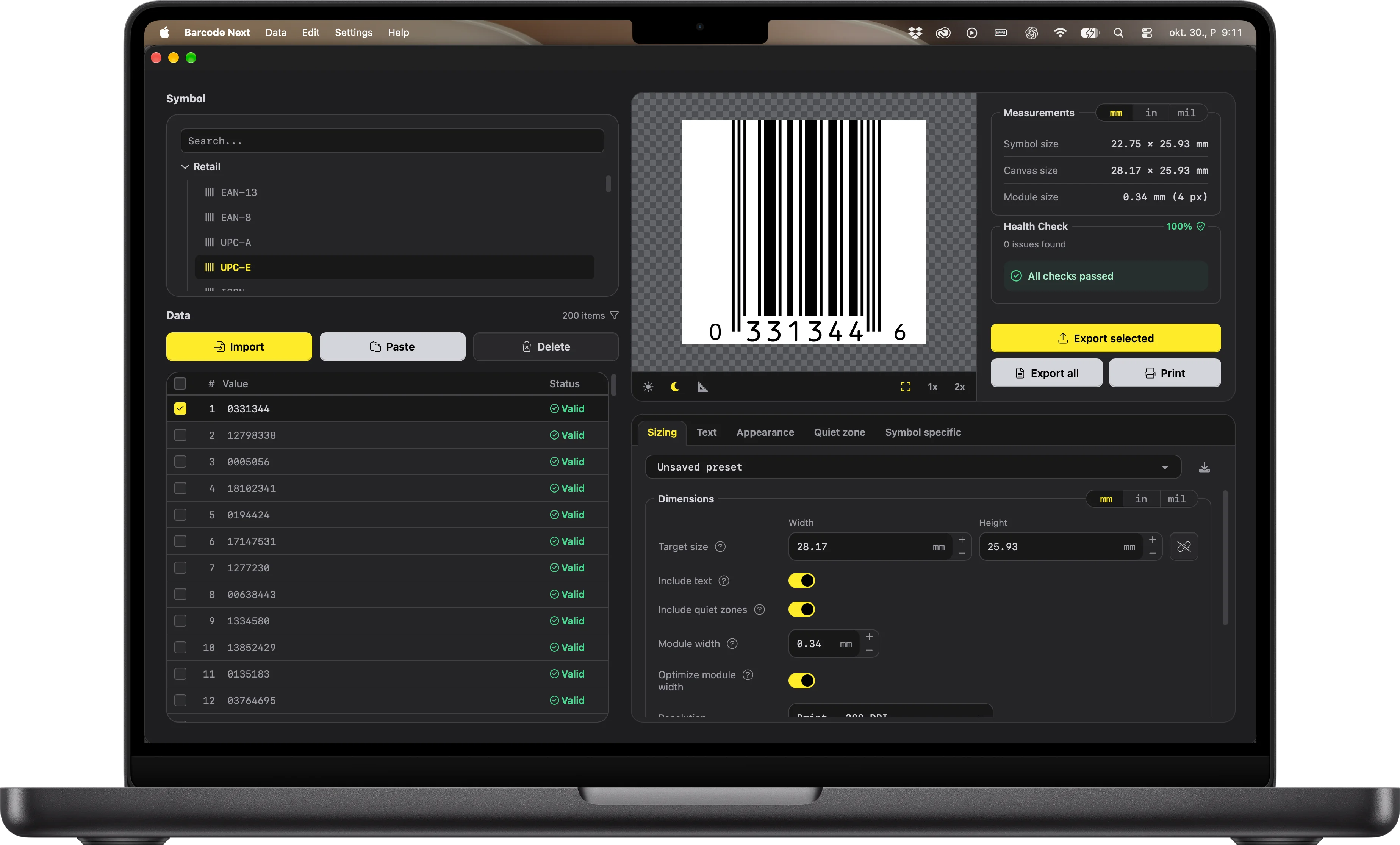
What is UPC-E?
UPC-E is a compressed form of UPC used when a full UPC-A symbol is too wide for the available packaging area. It represents a subset of UPC values that can be expressed using zero-suppression rules.
Because not every UPC-A value can be represented as UPC-E, the format requires additional validation beyond simply shortening the number. The compressed representation is useful for narrow packages, but it depends on the content of the underlying identifier and cannot be applied to arbitrary numerical strings.
Data requirements
UPC-E represents only UPC-A identifiers that satisfy specific zero-suppression rules. The check digit is derived from the expanded UPC-A number. Eligibility is determined by the prescribed zero-suppression cases. Correct conversion requires the appropriate number system and a check digit derived from the corresponding expanded UPC-A identifier, not simply a checksum of an isolated six-digit payload.
Structure and sizing
The compressed bar pattern omits the center guard found in UPC-A. The number-system digit and check digit are represented separately in the human-readable text. The symbol has no centre guard, unlike UPC-A. Its compact bar pattern still has specific start and end structures; reducing its width or omitting quiet zones can affect recognition even when the encoded identifier is valid.
Technical specifications
- Payload
- Six compressed digits, plus number-system/check information
- Source identifier
- Eligible UPC-A / GTIN-12 value
- Check digit
- Derived from the expanded UPC-A value
- Compression
- Only specified zero-suppression patterns
- Human-readable text
- Number system, payload and check digit
- Standard
- ISO/IEC 15420 and GS1 rules
- Example input type
- UPC-A → eligible UPC-E
UPC-E in Barcode Next
Why UPC-E has special validation
UPC-E is a compact representation of certain UPC-A identifiers. It relies on prescribed zero-suppression rules rather than removing arbitrary leading or trailing zeroes.
A valid UPC-E interpretation includes the number system and the check digit, even though the bar pattern contains a compressed payload.
Systems exchanging UPC identifiers may expand a UPC-E value back to its UPC-A equivalent. Verify the receiving system’s expected form.

Batch generation
Import CSV or XLSX data, validate individual records and generate multiple barcodes in one workflow.

Vector and raster export
Export scalable SVG, PDF or EPS files and high-resolution PNG, JPEG or TIFF images for production.

Label printing
Arrange barcodes on label sheets using presets or custom paper sizes, margins and grid layouts.
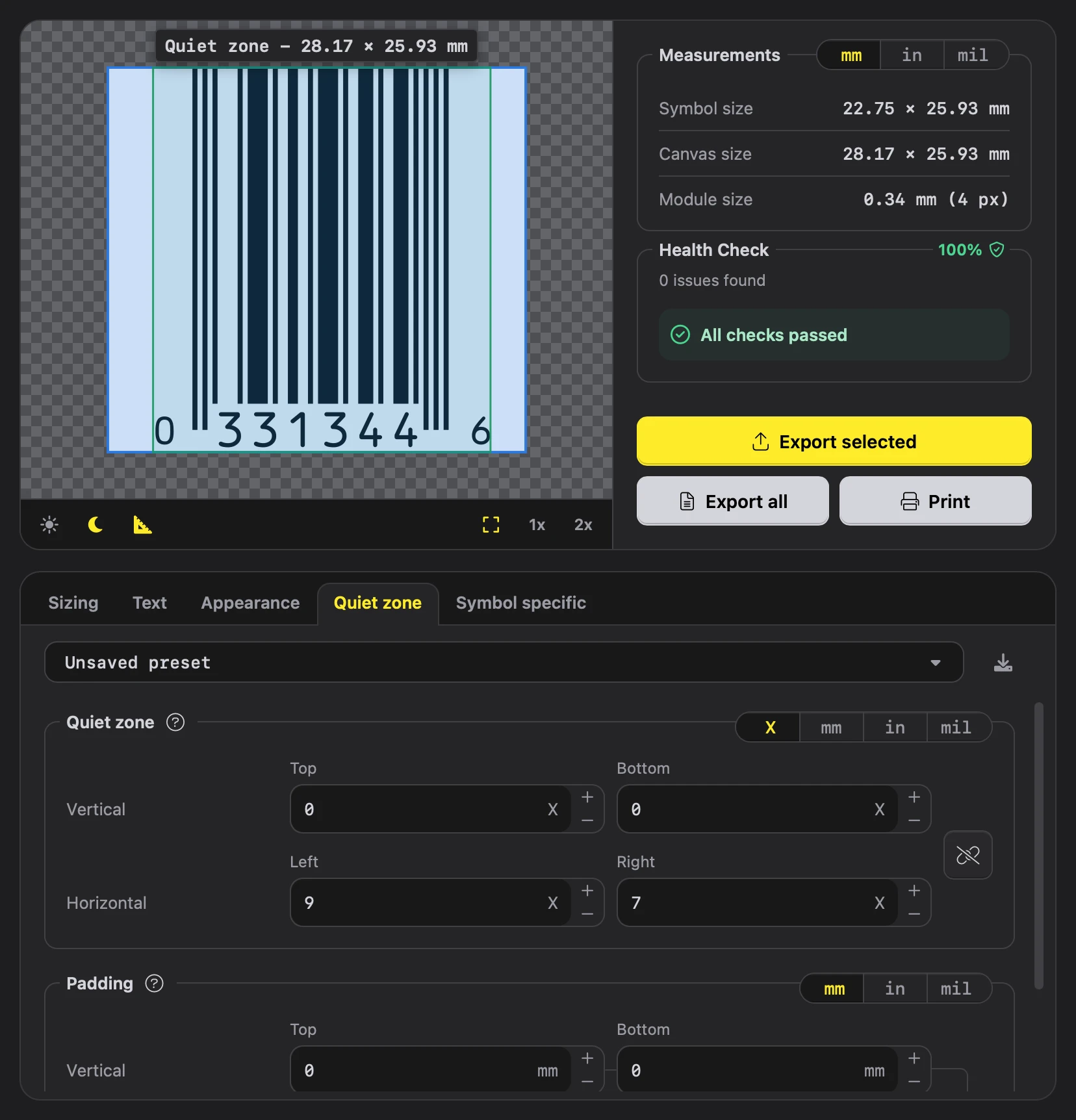
Available options depend on the selected symbology. The screenshot illustrates shared application controls, not a verified scan result for UPC-E.
Common issues and print considerations
Assuming all UPC-A values compress
Only numbers matching an eligible pattern can be expressed in UPC-E.
Treating six digits as the complete GTIN
The compressed symbol is related to a full UPC identifier; its checksum is determined through the expanded value.
Technical basis: GS1 General Specifications, release 26.0 (2026). Application and print specifications can impose additional requirements.
UPC-E questions
Can any UPC-A barcode be converted to UPC-E?
No. UPC-E is limited to UPC-A identifiers that satisfy particular zero-suppression rules.
Does UPC-E have a check digit?
Yes. Its check digit is determined from the corresponding expanded UPC-A identifier.
Create UPC-E with Barcode Next
Work with format-specific data rules, precise dimensions, validation and clear previews in a professional barcode editor for Mac and Windows.
Explore all features or compare the Mac and Windows editions.
Get started with Barcode Next
Download for free
Explore barcode formats, customize QR codes, prepare batches and preview label layouts.
Download