 Barcode Next
Code 128 barcode
Generate compact, high-density Code 128 barcodes for logistics, inventory and general-purpose identification with data validation and file export.
Inventory, asset identification and internal logistics labels
What is Code 128?
Code 128 is a high-density linear barcode used across logistics, inventory, shipping, asset identification and many general-purpose workflows.
It supports a much broader character set than retail-only numeric formats and can switch between different code sets to encode data efficiently. This makes it a common choice when identifiers contain letters, numbers or mixed content. Unlike GS1-128, ordinary Code 128 does not automatically impose GS1 Application Identifier semantics; choosing the correct format matters when the receiving system expects standardized supply-chain data.
Data requirements
Code 128 uses code sets A, B and C to encode characters and numeric pairs. A symbol-level Modulo 103 check character is mandatory. The symbol's mandatory Modulo 103 check character is derived from the codeword sequence, including any code-set changes. It is not the same as an optional check digit that might be part of an application-level identifier.
Structure and sizing
Each symbol contains a start character, data codewords, a check character and a stop pattern. Physical width varies with payload length and the selected code-set sequence. Numeric pairs encoded with set C can make a symbol substantially shorter than using individual digits in another set. Actual width nevertheless depends on start, shift, check and stop codewords as well as the clear zones around the bars.
Technical specifications
- Content
- Broad alphanumeric and control-character range
- Code sets
- A, B and C
- Code set C
- Pairs of numeric digits
- Symbol checksum
- Mandatory Modulo 103
- Length
- Variable; physical width depends on data
- Standard
- ISO/IEC 15417
- Example payload
- ITEM-0427
Code 128 in Barcode Next
Choosing the most suitable encoding
Code 128 has three code sets. Code set C encodes numeric pairs efficiently, while sets A and B cover different character ranges. Encoders can switch code sets within one symbol.
Symbol length grows with the number and kind of characters. Compare the resulting width and module size against available label space rather than relying on character count alone.
Code 128 is a general symbology. When a trading partner specifically requires GS1 Application Identifiers, use GS1-128 rather than ordinary Code 128.

Batch generation
Import CSV or XLSX data, validate individual records and generate multiple barcodes in one workflow.

Vector and raster export
Export scalable SVG, PDF or EPS files and high-resolution PNG, JPEG or TIFF images for production.

Label printing
Arrange barcodes on label sheets using presets or custom paper sizes, margins and grid layouts.
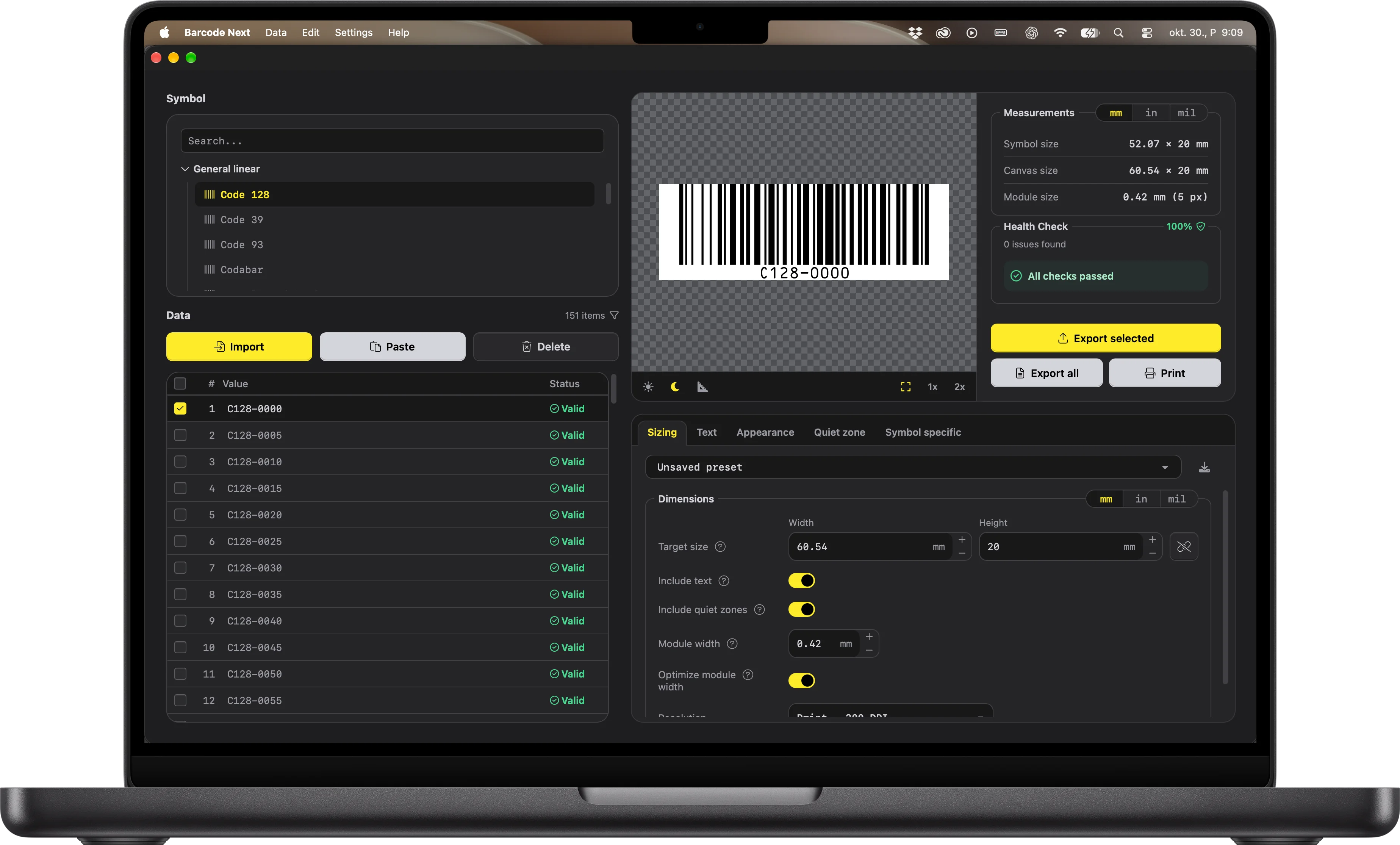
Available options depend on the selected symbology. The screenshot illustrates shared application controls, not a verified scan result for Code 128.
Common issues and print considerations
Confusing Code 128 with GS1-128
A generic Code 128 symbol does not automatically have the FNC1 and GS1 data structure required by GS1-128.
Overly dense narrow labels
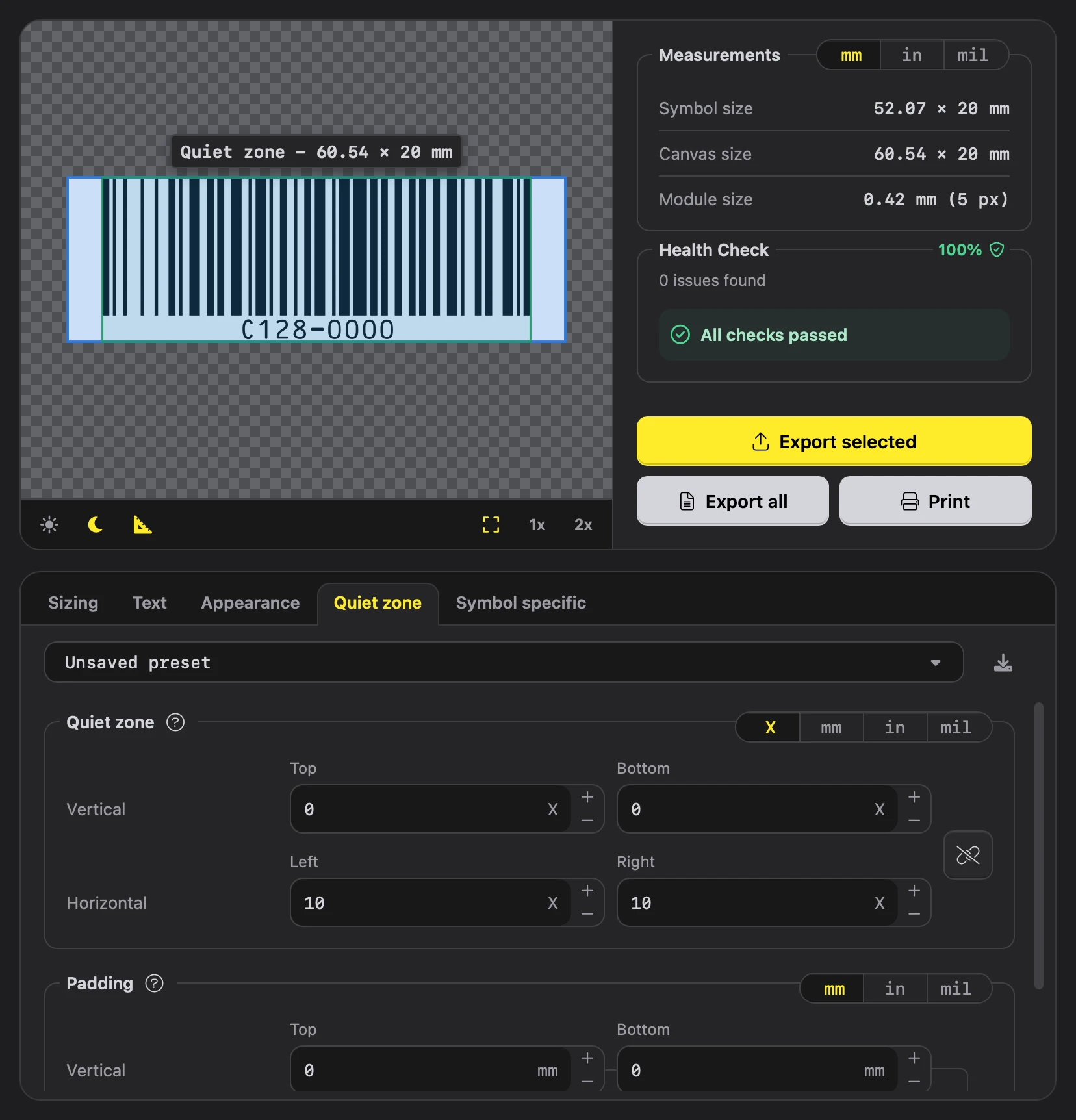
Long payloads may require a wider symbol or larger physical module width.
Technical basis: ISO/IEC 15417 (Code 128). Application and print specifications can impose additional requirements.
Code 128 questions
Is Code 128 numeric only?
No. It can represent a broad character range using code sets A, B and C.
Is the Code 128 check character optional?
No. A symbol-level Modulo 103 check character is required.
Create Code 128 with Barcode Next
Work with format-specific data rules, precise dimensions, validation and clear previews in a professional barcode editor for Mac and Windows.
Explore all features or compare the Mac and Windows editions.
Get started with Barcode Next
Download for free
Explore barcode formats, customize QR codes, prepare batches and preview label layouts.
Download