 Barcode Next
Code 39 barcode
Create Code 39 barcodes for identification, industrial and legacy workflows with precise sizing, readable text and file export.
Industrial and legacy asset identification
What is Code 39?
Code 39 is a widely recognized linear barcode format used in industrial, government, automotive and internal identification workflows.
Compared with Code 128 it is less dense, but its straightforward character set and long history mean it remains important in systems where Code 39 is already part of an established specification or process. In the basic alphabet, lowercase letters are not supported directly. Extended Code 39 can represent additional ASCII characters through combinations, but a reader must explicitly support that convention.
Data requirements
Basic Code 39 accepts uppercase letters, digits and selected punctuation. The start and stop patterns are required; the Modulo 43 check character is optional unless mandated by the receiving specification. The start/stop character is represented by an asterisk pattern; software usually supplies it rather than treating the surrounding asterisks as ordinary content. A Modulo 43 check character is optional and should follow the requirements of the receiving system.
Structure and sizing
Characters consist of narrow and wide bars and spaces, resulting in a relatively low-density linear symbol. Width increases with each character; quiet zones and adequate bar height remain important. Each character uses five bars and four spaces, with three wide elements. Inter-character gaps increase the total width, so a long asset identifier may need significantly more label space than the same data in Code 128.
Technical specifications
- Core character set
- A–Z, 0–9 and selected punctuation
- Start / stop
- Asterisk character (*) patterns
- Check character
- Optional Modulo 43
- Width
- Variable with payload length
- Full ASCII
- Requires a separate extended encoding convention
- Standard
- ISO/IEC 16388
- Example payload
- ASSET-204
Code 39 in Barcode Next
A familiar industrial format with limits
Code 39 remains common in established industrial workflows. Its native alphabet uses uppercase letters, numbers, spaces and a limited set of punctuation.
A Modulo 43 check character can be required by a particular system, but it is not a universal part of every Code 39 payload.
Lowercase characters and other ASCII values need the extended Full ASCII convention and a compatible decoder; this is not equivalent to native lowercase support.

Batch generation
Import CSV or XLSX data, validate individual records and generate multiple barcodes in one workflow.

Vector and raster export
Export scalable SVG, PDF or EPS files and high-resolution PNG, JPEG or TIFF images for production.

Label printing
Arrange barcodes on label sheets using presets or custom paper sizes, margins and grid layouts.
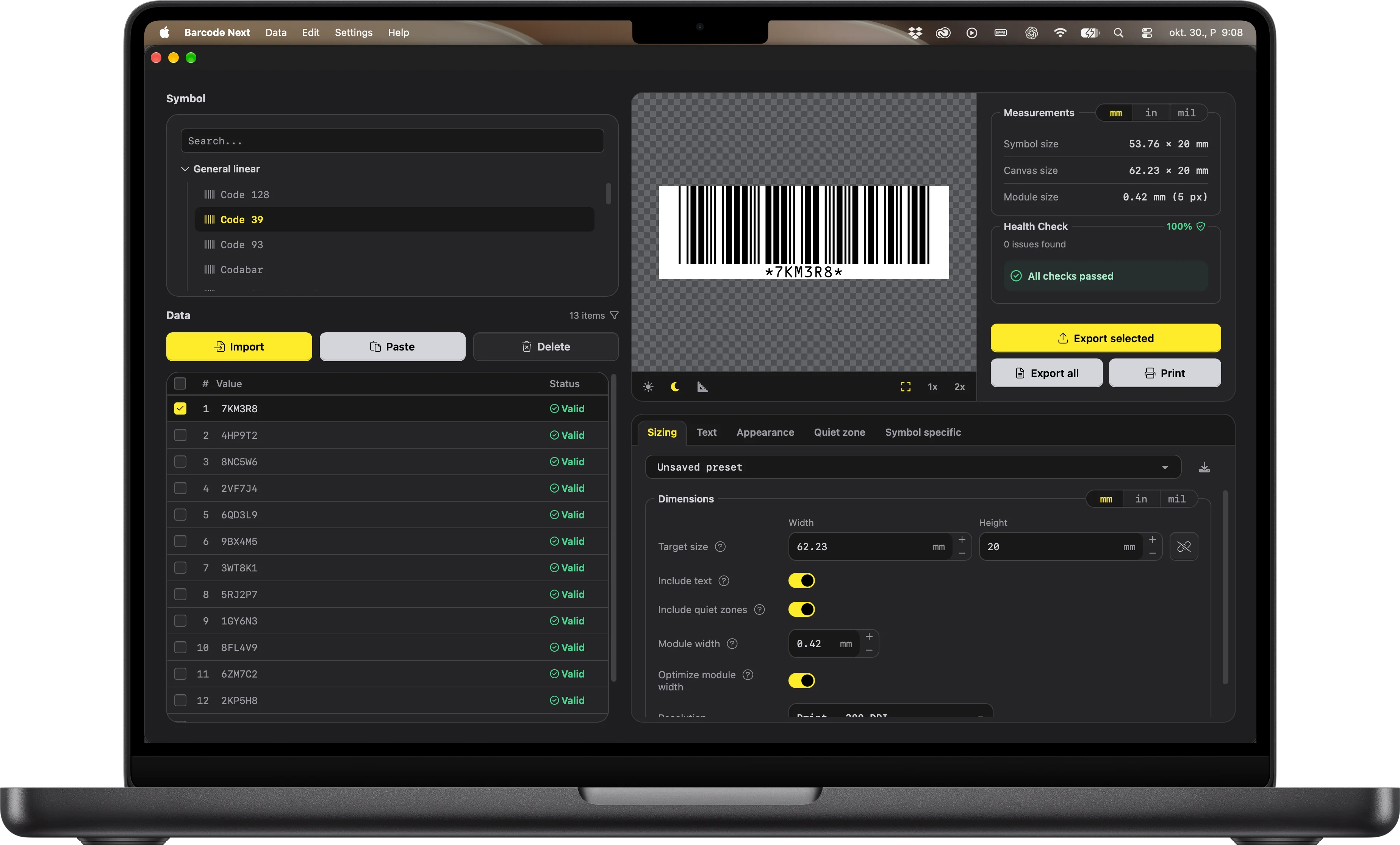
Available options depend on the selected symbology. The screenshot illustrates shared application controls, not a verified scan result for Code 39.
Common issues and print considerations
Lowercase in a basic Code 39 symbol
Basic Code 39 does not include lowercase letters as native characters.
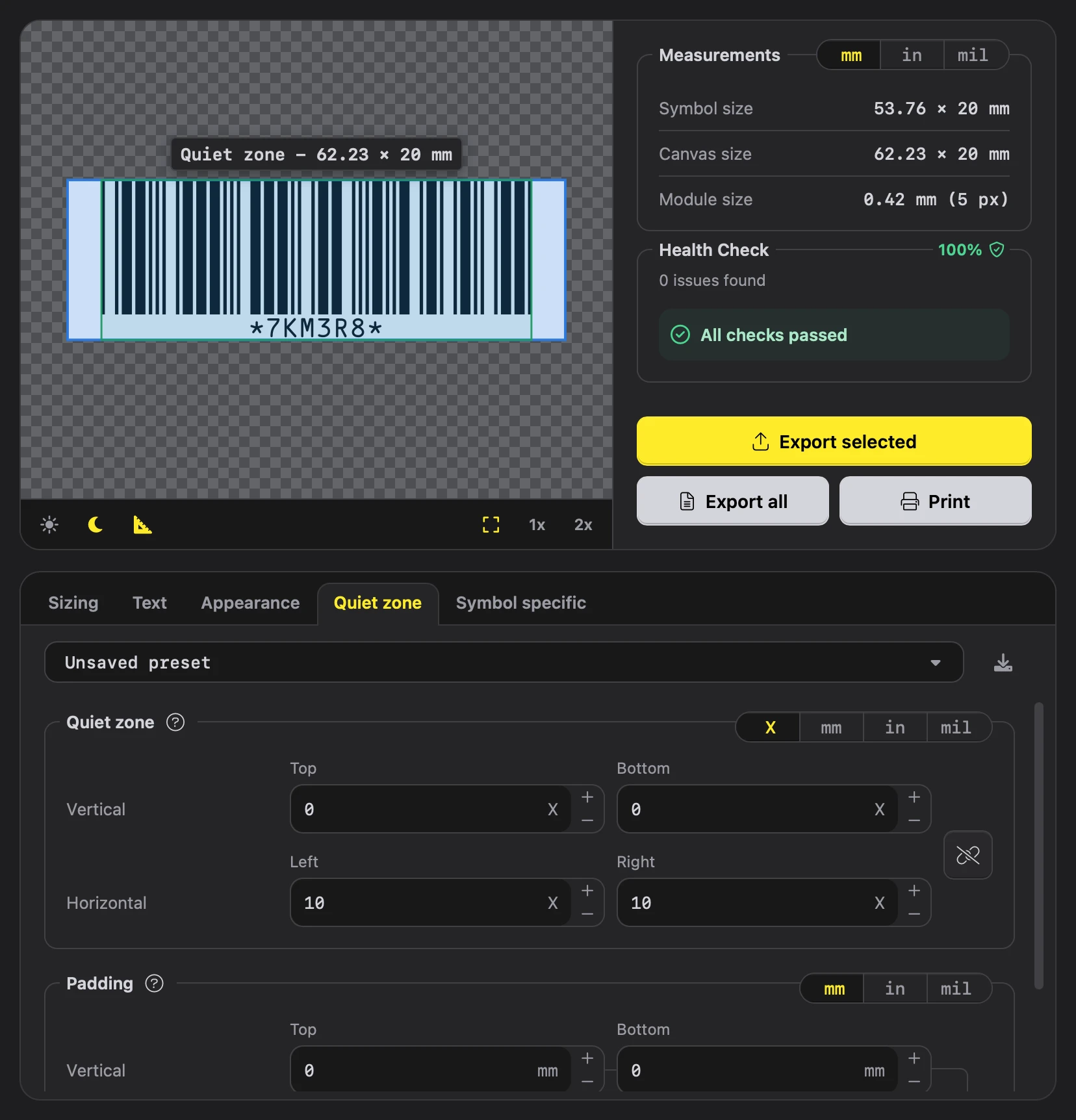
Incorrect start/stop treatment
The asterisk represents the required start/stop pattern; software commonly inserts it automatically.
Technical basis: ISO/IEC 16388 (Code 39). Application and print specifications can impose additional requirements.
Code 39 questions
Does Code 39 require a check digit?
Not universally. Modulo 43 is optional, depending on the receiving specification.
Can Code 39 store lowercase letters?
Not directly in its basic alphabet; extended Full ASCII encoding requires compatible readers.
Create Code 39 with Barcode Next
Work with format-specific data rules, precise dimensions, validation and clear previews in a professional barcode editor for Mac and Windows.
Explore all features or compare the Mac and Windows editions.
Get started with Barcode Next
Download for free
Explore barcode formats, customize QR codes, prepare batches and preview label layouts.
Download