 Barcode Next
PDF417 barcode
Generate PDF417 barcodes for high-capacity 2D data workflows with configurable sizing, error correction and file export.
Documents, transport applications and high-capacity data
What is PDF417?
PDF417 is a stacked two-dimensional barcode made from multiple rows of linear codewords. It is designed to carry substantially more data than typical 1D barcodes while retaining a rectangular form that works well in documents and identification workflows.
The symbol can be configured with different row/column arrangements and error-correction levels. The format is often chosen when a structured record must be encoded directly in the symbol rather than being referenced by a simple identifier or URL.
Data requirements
PDF417 can encode text and binary data. The payload, error-correction level and selected row/column settings must fit within the permitted symbol capacity. PDF417 encoders choose among text, numeric and byte compaction methods. Payload size, selected error-correction level and row/column limits must agree; otherwise the requested symbol cannot contain all codewords.
Structure and sizing
The symbol comprises stacked rows of codewords, including start and stop patterns and row indicators. Its aspect ratio depends on the row count, column count and physical module dimensions. Each row contains identifying and data codewords framed by start and stop patterns. Changing row height or column count alters the symbol's aspect ratio; narrow modules or insufficient row height can make dense printed symbols harder to scan.
Technical specifications
- Structure
- Stacked rows of linear codewords
- Rows / columns
- Configurable within symbology limits
- Error correction
- Selectable Reed–Solomon levels
- Payload
- Variable text and binary data
- Physical size
- Depends on columns, rows and module dimensions
- Standard
- ISO/IEC 15438
- Example payload
- DOC-2026-0042
PDF417 in Barcode Next
A barcode built from rows
PDF417 differs from square matrix codes: it uses multiple stacked, self-contained rows with start, stop and row-indicator structures.
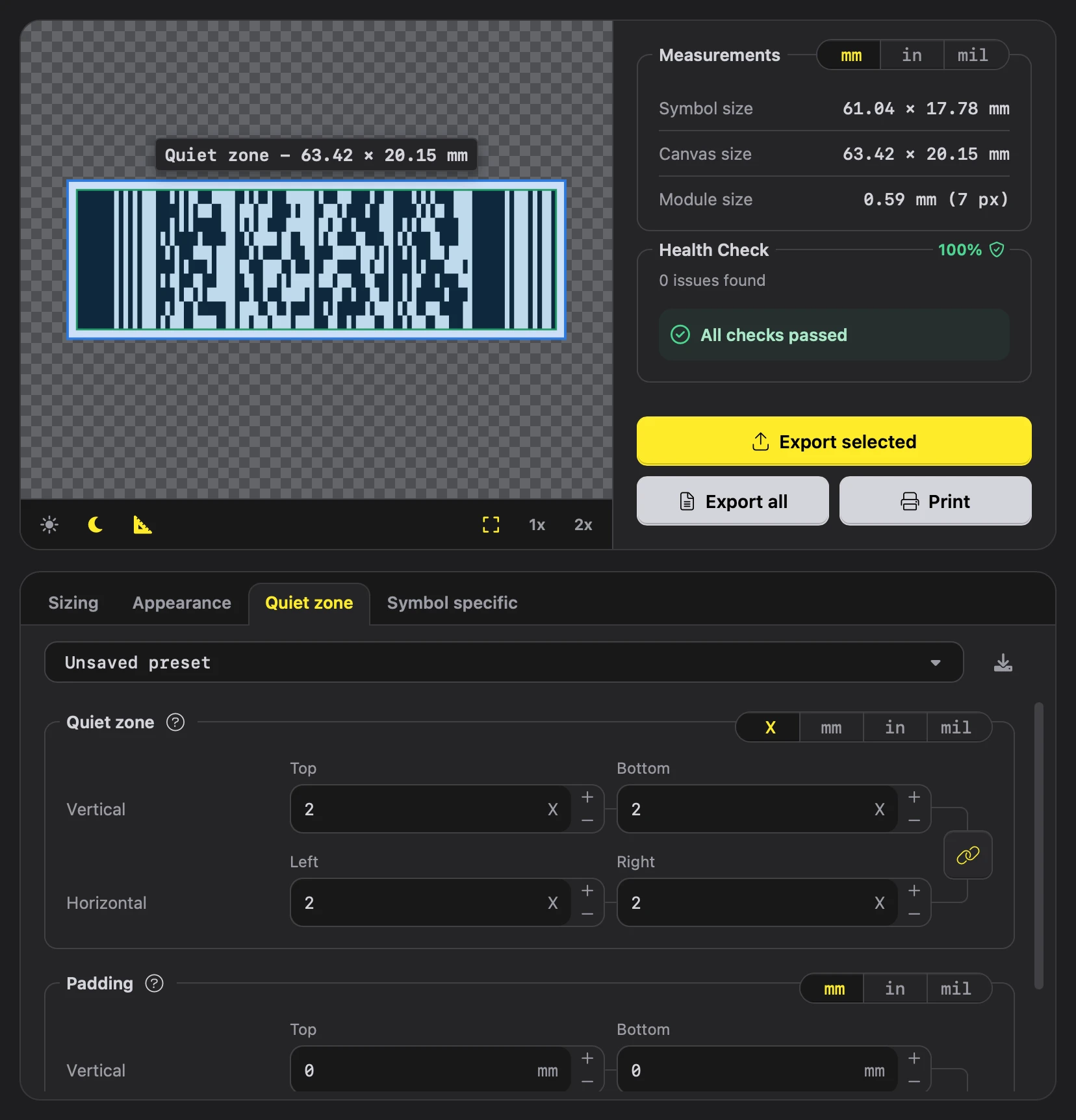
The row and column configuration affects the final aspect ratio. More content or stronger error correction can increase the symbol size.
Wide symbols, inadequate row height or poor printing resolution can reduce scan reliability, especially on densely packed documents.

Batch generation
Import CSV or XLSX data, validate individual records and generate multiple barcodes in one workflow.

Vector and raster export
Export scalable SVG, PDF or EPS files and high-resolution PNG, JPEG or TIFF images for production.

Label printing
Arrange barcodes on label sheets using presets or custom paper sizes, margins and grid layouts.
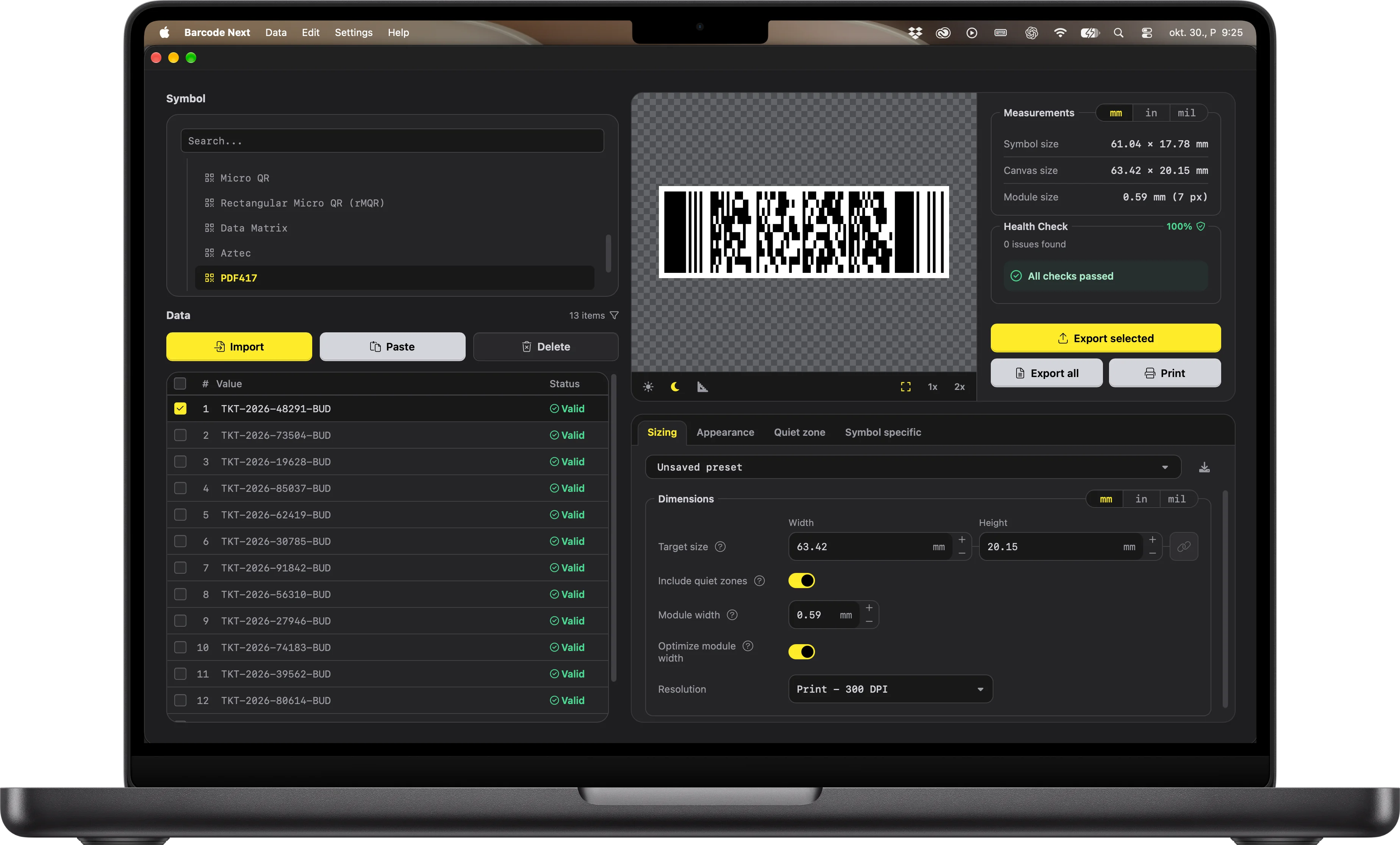
Available options depend on the selected symbology. The screenshot illustrates shared application controls, not a verified scan result for PDF417.
Common issues and print considerations
Treating PDF417 as a QR Code
PDF417 uses a row/column architecture with different decoding and dimensional constraints.
Forcing too few rows or columns
A payload and correction level must fit within a permissible configuration.
Technical basis: ISO/IEC 15438 (PDF417). Application and print specifications can impose additional requirements.
PDF417 questions
Is PDF417 a matrix barcode?
It is a stacked 2D symbology, arranged in rows of codewords rather than a conventional square matrix grid.
Can PDF417 store more than simple numbers?
Yes. It supports text and binary data using defined compaction methods.
Create PDF417 with Barcode Next
Work with format-specific data rules, precise dimensions, validation and clear previews in a professional barcode editor for Mac and Windows.
Explore all features or compare the Mac and Windows editions.
Get started with Barcode Next
Download for free
Explore barcode formats, customize QR codes, prepare batches and preview label layouts.
Download