 Barcode Next
GS1 DataMatrix barcode
Build GS1 DataMatrix symbols from structured Application Identifier data with validation, compact output and batch-ready production workflows.
Compact structured identifiers and traceability applications
What is GS1 DataMatrix?
GS1 DataMatrix combines the compact Data Matrix ECC 200 symbol with GS1's structured Application Identifier system.
It is widely used when supply-chain or product data needs to fit into a small 2D symbol, including regulated and traceability-oriented workflows. The compact matrix can carry several attributes in one symbol, including a GTIN, expiry date or serial number, when the appropriate Application Identifiers are used.
Data requirements
GS1 DataMatrix uses GS1 Application Identifiers with fixed- or variable-length fields. Required FNC1 signalling and field separators distinguish the encoded data from ordinary Data Matrix text. AI fields have prescribed lengths and permitted character types. The required FNC1 signalling distinguishes GS1 DataMatrix from ordinary ECC 200; variable-length values need separators when another field follows, rather than literal parentheses typed into the encoded payload.
Structure and sizing
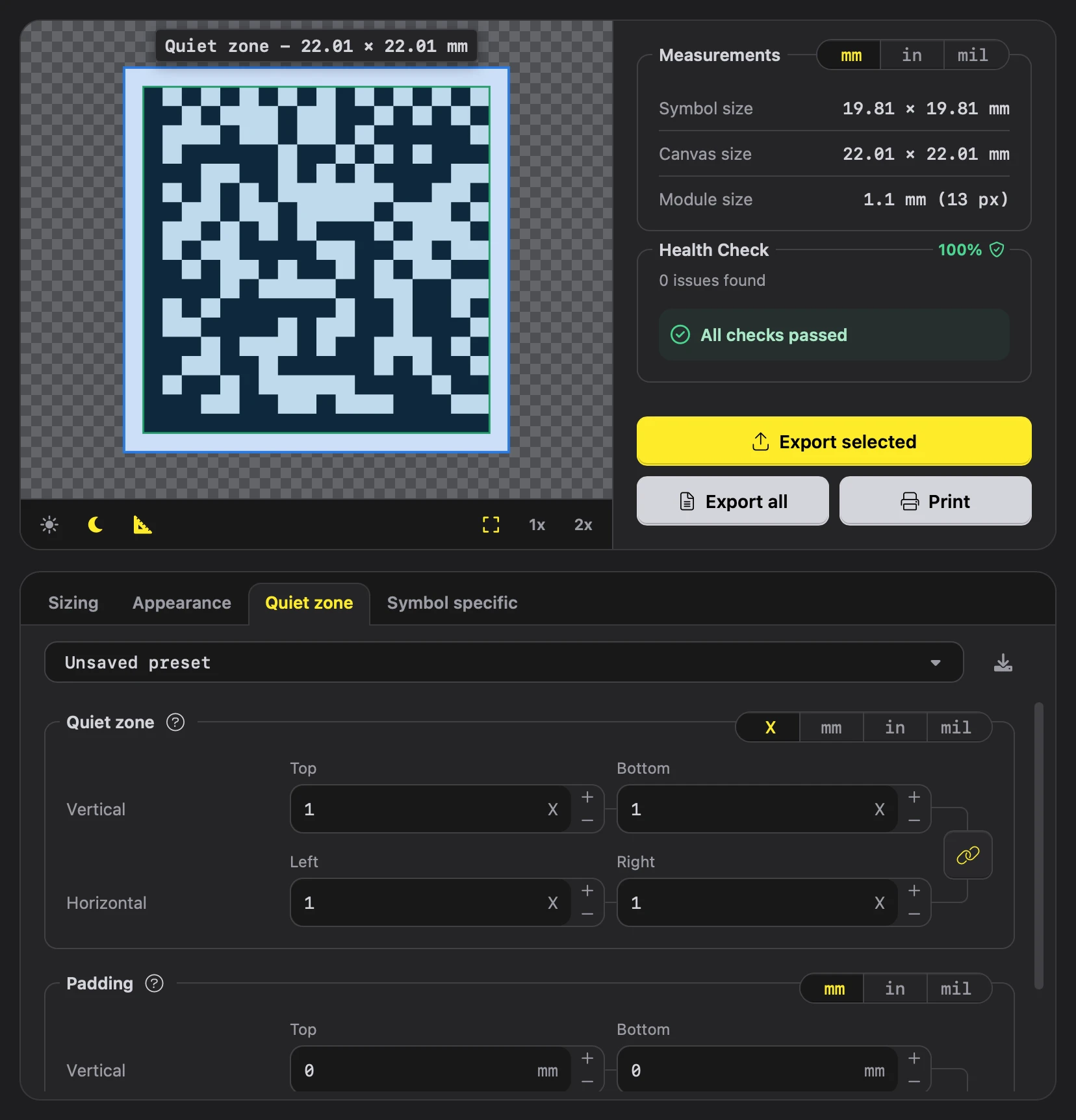
It retains the ECC 200 Data Matrix layout: an L-shaped finder border, timing edges and a module grid sized to the payload. A clear surrounding quiet zone is required. Its ECC 200 geometry uses an L-shaped finder and alternating timing borders. Symbol dimensions depend on the encoded data and selected module size, while clear margins and marking quality must satisfy the specific application and scanner environment.
Technical specifications
- Carrier
- Data Matrix ECC 200
- Content
- GS1 AI element strings
- GS1 signalling
- FNC1 in the required position
- Finder
- L-shaped Data Matrix border
- Quiet zone*
- 1X on all sides
- Standard
- GS1 General Specifications
- Human-readable GS1 example
- (01)09506000134352(17)271231(10)LOT42
* Quiet zone values are minimum clearances, not fixed margins. Larger clear areas are allowed; the application may require additional space.
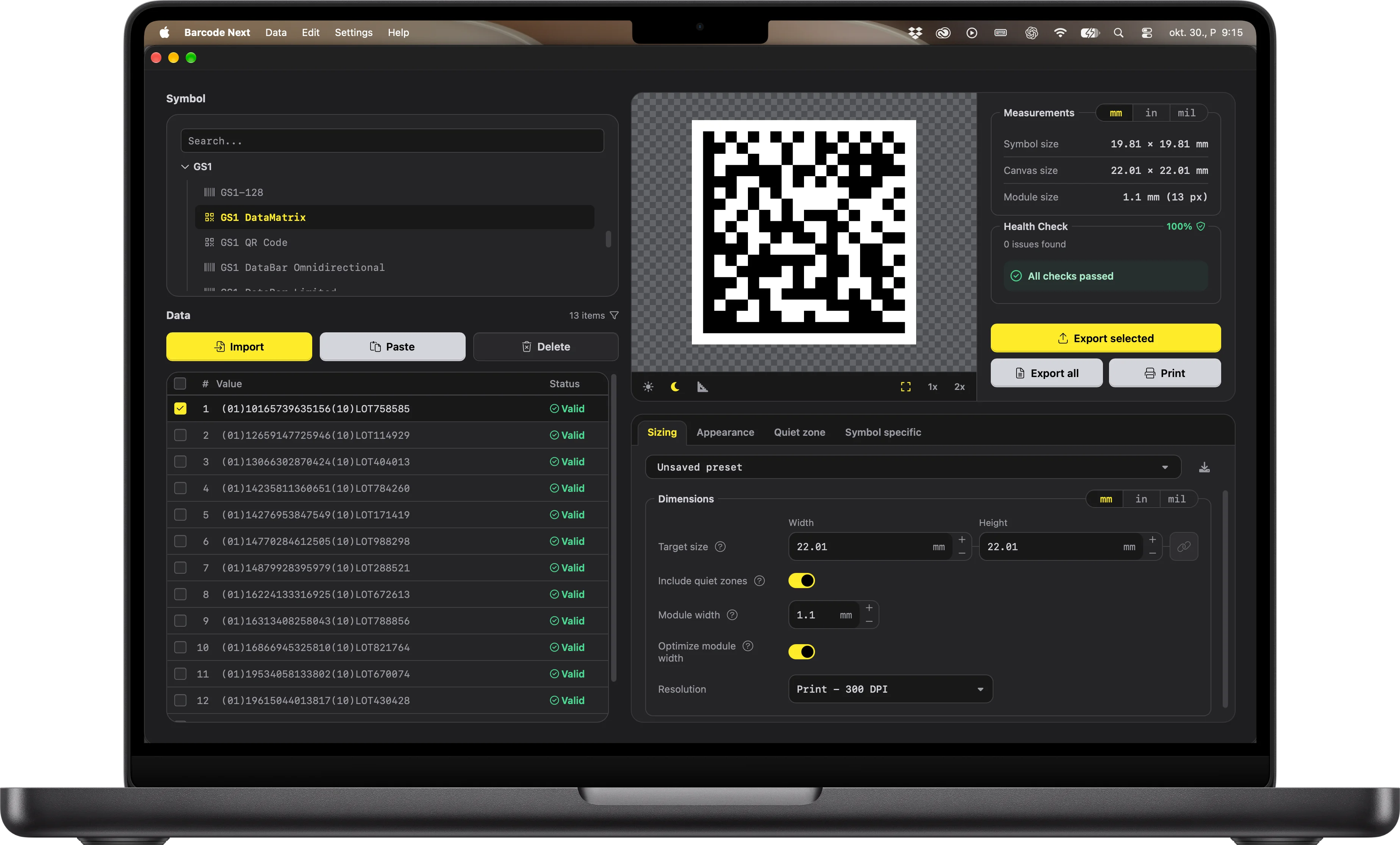
GS1 DataMatrix in Barcode Next
Data Matrix geometry with GS1 semantics
GS1 DataMatrix is not simply a Data Matrix symbol containing visible GS1-style text. It follows GS1 AI syntax and uses the designated FNC1 signalling.
The carrier is valuable when the available marking area is small, such as on medical products or industrial components, subject to relevant application requirements.
Validating AI data is separate from verifying printing and scanning performance. Symbol dimensions, quiet zones and final marking method must all be considered.

Batch generation
Import CSV or XLSX data, validate individual records and generate multiple barcodes in one workflow.

Vector and raster export
Export scalable SVG, PDF or EPS files and high-resolution PNG, JPEG or TIFF images for production.

Label printing
Arrange barcodes on label sheets using presets or custom paper sizes, margins and grid layouts.
Available options depend on the selected symbology. The screenshot illustrates shared application controls, not a verified scan result for GS1 DataMatrix.
Common issues and print considerations
Missing GS1 signalling
A generic Data Matrix symbol with a GTIN-like string is not automatically GS1 DataMatrix.
Incorrect AI lengths
Fixed- and variable-length GS1 fields must use their defined content rules and separators.
Technical basis: GS1 General Specifications, release 26.0 (2026). Application and print specifications can impose additional requirements.
GS1 DataMatrix questions
How is GS1 DataMatrix different from Data Matrix?
GS1 DataMatrix uses the same underlying ECC 200 geometry but includes GS1 data and FNC1 conventions.
Can GS1 DataMatrix encode batch and expiry data?
Yes, when the relevant GS1 Application Identifiers and values are properly encoded.
Create GS1 DataMatrix with Barcode Next
Work with format-specific data rules, precise dimensions, validation and clear previews in a professional barcode editor for Mac and Windows.
Explore all features or compare the Mac and Windows editions.
Get started with Barcode Next
Download for free
Explore barcode formats, customize QR codes, prepare batches and preview label layouts.
Download